West Denton Primary School
History
At West Denton Primary School, we value a high-quality history curriculum that inspires curiosity and deepens pupils’ understanding of the world. By exploring how societies, events and individuals have shaped the past, children develop a clearer understanding of the present and their place within it.
Our curriculum supports pupils in building secure knowledge, a strong sense of chronology and an understanding of key historical concepts as they progress through school. We encourage children to ask perceptive questions, think critically, analyse evidence and form balanced judgements. Through studying a wide range of societies and cultures, pupils develop an appreciation of diversity and a strong sense of identity and belonging.
History is taught in a cross-curricular way, enabling pupils to make meaningful links across subjects. Our West Denton values promote positive learning behaviours and help prepare pupils for the future, equipping them to understand change, reflect on the complexity of people’s lives and engage thoughtfully with the world around them.
Historical Concepts
At West Denton Primary School, three key historical concepts are woven throughout our curriculum:
Empire
Empire is a significant concept in both British and world history. As this is an abstract idea, it is introduced gradually and thoughtfully. In Key Stage 1, pupils begin by learning about the British monarchy and what it means to rule a country. In Key Stage 2, they explore why countries and civilisations have sought to expand their influence and power. As pupils progress, they develop a deeper understanding of empire and apply this knowledge across different historical periods.
Innovation
We recognise that innovation has driven change throughout history. Pupils explore how inventions and developments in different eras have shaped societies and influenced the way people live. This understanding enables children to evaluate the impact of innovation and consider how modern developments may continue to shape the future.
Civilisation
Pupils are introduced to a wide range of civilisations, including British, European and those from across the wider world. This broad exposure helps children develop a deeper understanding of cultural diversity and ways of life throughout history. As they progress, pupils make comparisons between civilisations, analyse what contributes to a successful society and reflect on how these lessons apply to their own community and the modern world.
National Curriculum Aims
The aims of this are to ensure that all pupils:
- Know and understand the history of Britain as a coherent, chronological narrative, from earliest times to the present day
- Understand how people’s lives have shaped the nation and how Britain has influenced and been influenced by the wider world
- Gain knowledge of significant aspects of world history, including ancient civilisations, empires and non-European societies
- Develop an understanding of key historical concepts such as continuity and change, cause and consequence, similarity and difference, and significance
- Use historical enquiry skills to ask questions, analyse evidence and construct informed interpretations of the past
- Gain historical perspective by making connections between local, regional, national and international history, and across different time periods
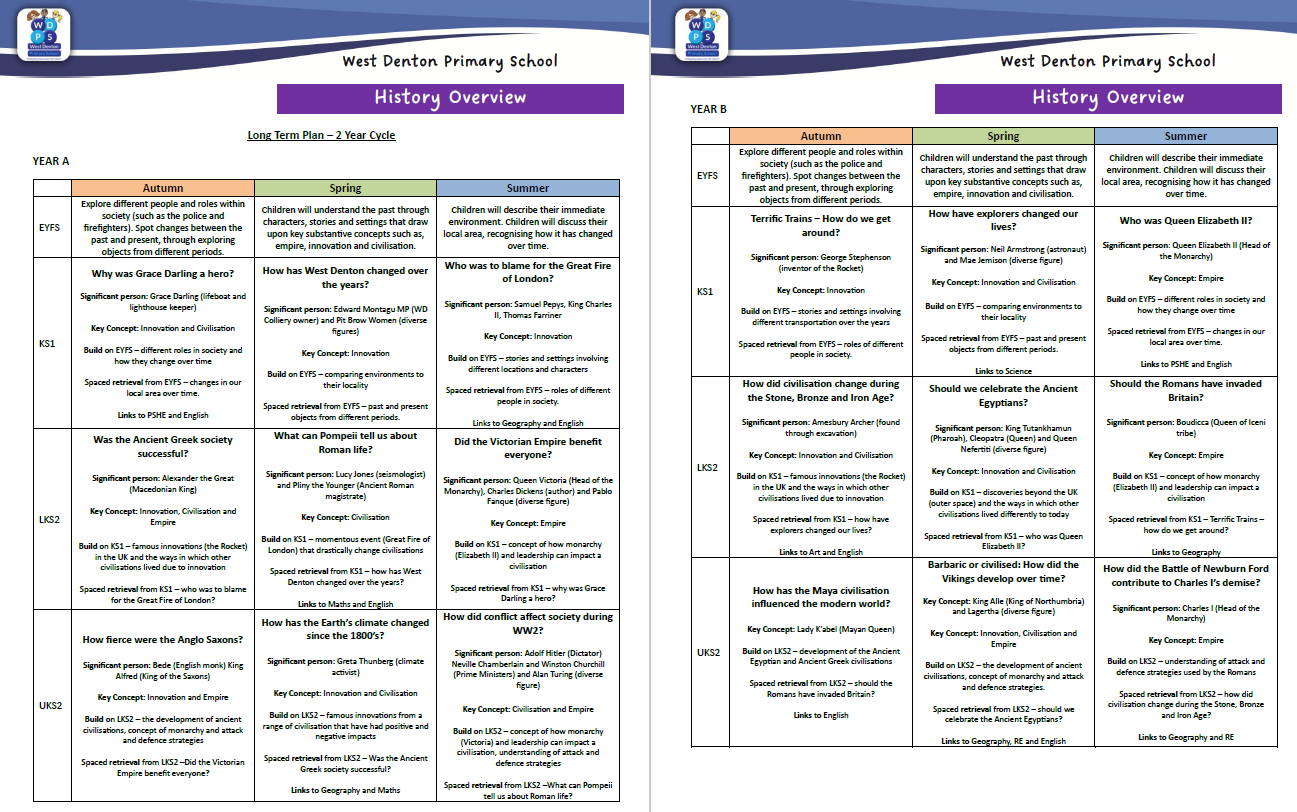
Overview