West Denton Primary School
Mathematics
At West Denton Primary School, we recognise that mathematics is essential to everyday life and equips pupils with the skills to understand and shape the world. We aim to develop confident, enthusiastic learners who approach mathematics with a positive attitude that extends beyond their time in school.
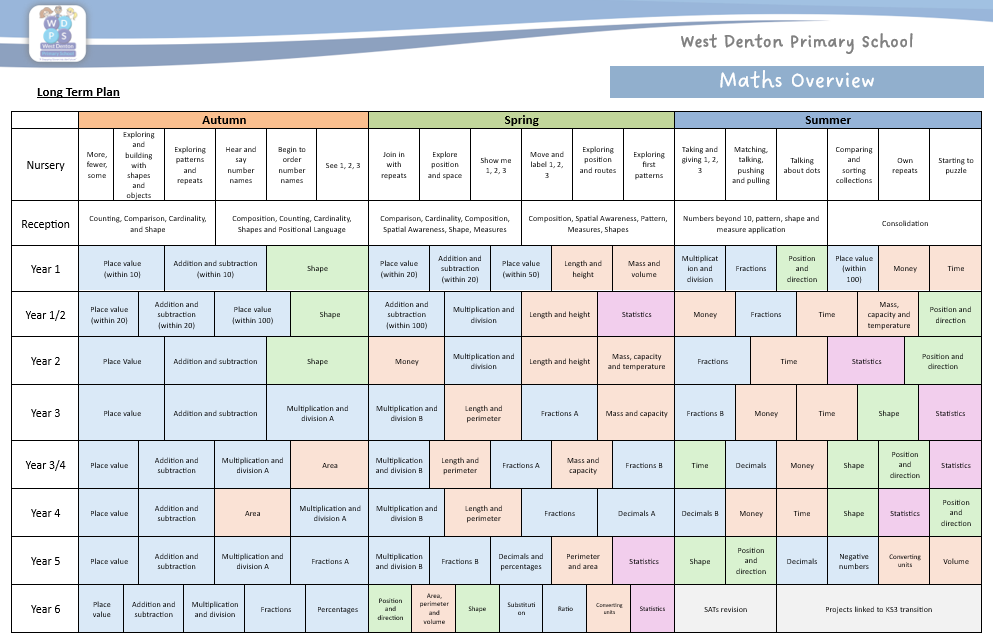
Our curriculum follows a mastery approach, guided by the NCETM progression framework in Reception and White Rose Education from Year 1 to Year 6. Through collaboration with other schools and specialist support, we ensure high-quality teaching and consistent best practice.
Learning is carefully sequenced to build cumulatively, with regular opportunities to revisit and deepen prior knowledge. This supports pupils in developing strong reasoning, problem-solving and abstract thinking skills. We focus on “keeping up, not catching up,” underpinned by high expectations and the belief that all children can succeed in mathematics.
Through effective assessment, purposeful practice and opportunities to apply learning across the curriculum and in real-life contexts, pupils build resilience, independence and confidence. This ensures they develop a secure understanding of key concepts, achieve age-related mastery and are well-prepared for the next stage of their education and beyond.
National Curriculum Aims
At West Denton Primary School, we recognise that mathematics is an essential life skill. We aim to develop confident, enthusiastic learners who have a positive attitude towards mathematics that will support them throughout their lives. By fostering this mindset, we help pupils build confidence and achieve success in a subject that is vital in modern society.
We provide a high-quality mathematics curriculum that develops pupils into numerate, independent, inquisitive and resilient learners. Through engaging teaching, real-life contexts and effective use of resources, we ensure that all children are supported to reach their full potential.
Our pupils are supported to:
- Develop a secure understanding of number, including place value and how numbers relate within the number system
- Recall key number facts fluently, including number bonds, multiplication tables, doubles and halves
- Use known facts to calculate mentally with confidence and efficiency
- Solve calculations accurately using a range of appropriate strategies, both mentally and written
- Understand when and how to use calculators effectively
- Solve a range of problems, including real-life and non-routine situations, and identify appropriate operations
- Explain their reasoning clearly using correct mathematical vocabulary
- Check solutions and assess whether answers are reasonable
- Use appropriate units of measurement and make sensible estimates
- Interpret and present data using graphs, charts, diagrams and tables
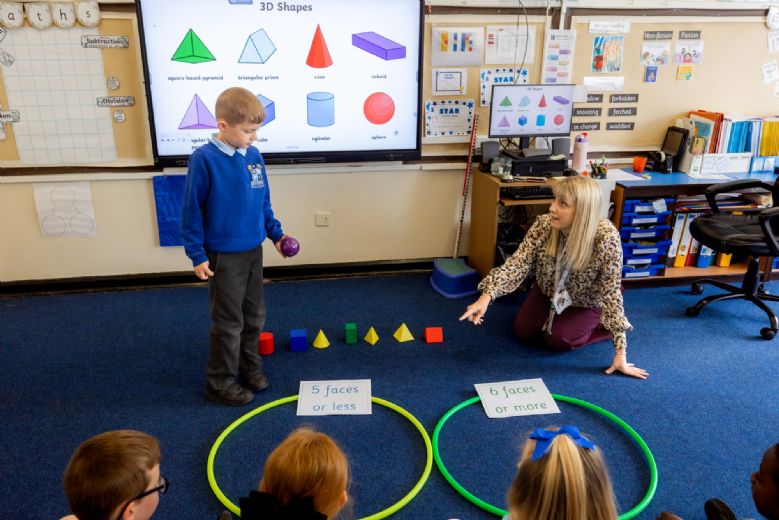
- Develop spatial awareness and an understanding of the properties of 2D and 3D shapes
Overview