West Denton Primary School
Design Technology
At West Denton Primary School, we are fully committed to providing children with an engaging, relevant and purposeful Design and Technology curriculum that prepares them for life beyond school. In a rapidly changing world, it is essential that children embrace technology and develop the skills needed to navigate future challenges. We aim to nurture collaborative, adaptable learners who can tackle real-life problems by drawing on a broad and rich skillset. We believe that Design Technology encourages children to think independently and innovatively while developing creative, procedural and technical understanding.
To embed and support learning, children make connections across skills, knowledge and experiences through our key concepts: belonging, choice and influence. Pupils explore designers and inventors from the West Denton community and beyond, considering how their work has shaped the world around them. This helps children see the relevance of DT in their own lives and fosters a strong sense of belonging. Choice is central to our curriculum, as pupils are presented with real-life challenges and encouraged to develop their own solutions. They evaluate options, make informed decisions and respond creatively in unique ways. Furthermore, by studying a range of designers and their products, children develop an understanding of the influence of DT in everyday life, including both its benefits and its challenges. Through this, pupils gain an appreciation of the important role Design and Technology plays in the 21st century.
National Curriculum Aims
Key Stage 1 pupils will be taught to:
Design
- design purposeful, functional, appealing products for themselves and other users based on design criteria.
- generate, develop, model and communicate their ideas through talking, drawing, templates, mock-ups and, where appropriate, information and communication technology.
- Children use their understanding of significant people in a given area to aid their own designs.
Make
- select from and use a range of tools and equipment to perform practical tasks [for example, cutting, shaping, joining and finishing].
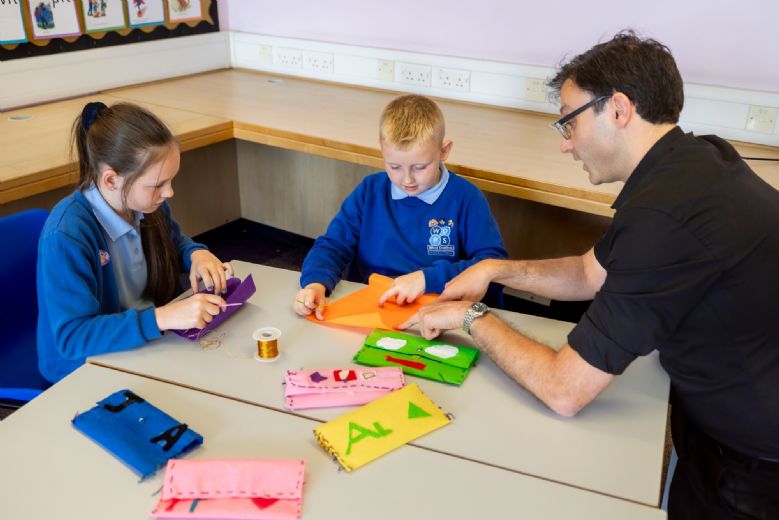
- select from and use a wide range of materials and components, including construction materials, textiles and ingredients, according to their characteristics.
Evaluate
- explore and evaluate a range of existing products and the work of significant designers.
- evaluate their ideas and products against design criteria.
Technical knowledge
- build structures, exploring how they can be made stronger, stiffer and more stable.
- explore and use mechanisms [for example, levers, sliders, wheels and axles], in their products.
Cooking and nutrition
- use the basic principles of a healthy and varied diet to prepare dishes.
- understand where food comes from.
Key Stage 2 pupils will be taught to:
Design
- use research and develop design criteria to inform the design of innovative, functional, appealing products that are fit for purpose, aimed at particular individuals or groups.
- generate, develop, model and communicate their ideas through discussion, annotated sketches, cross-sectional and exploded diagrams, prototypes, pattern pieces and computer-aided design.
- children will draw on design concepts used by significant designers to aid their own designs.
Make
- select from and use a wider range of tools and equipment to perform practical tasks [for example, cutting, shaping, joining and finishing], accurately.
- select from and use a wider range of materials and components, including construction materials, textiles and ingredients, according to their functional properties and aesthetic qualities.
Evaluate
- investigate and analyse a range of existing products.
- evaluate their ideas and products against their own design criteria and consider the views of others to improve their work.
- understand how key events and individuals in design and technology have helped shape the world.
Technical knowledge
- apply their understanding of how to strengthen, stiffen and reinforce more complex structures.
- understand and use mechanical systems in their products [for example, gears, pulleys, cams, levers and linkages].
- understand and use electrical systems in their products [for example, series circuits incorporating switches, bulbs, buzzers and motors].
- apply their understanding of computing to program, monitor and control their products.
Cooking and nutrition
- understand and apply the principles of a healthy and varied diet
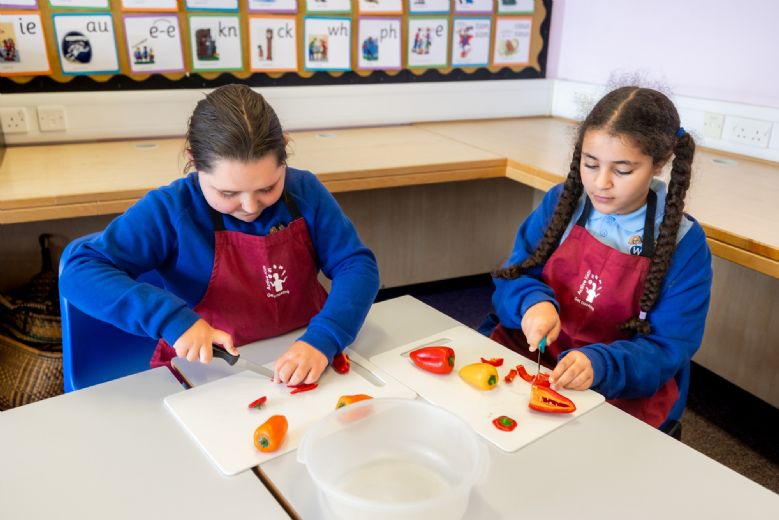
- prepare and cook a variety of predominantly savoury dishes using a range of cooking techniques.
- understand seasonality, and know where and how a variety of ingredients are grown, reared, caught and processed.
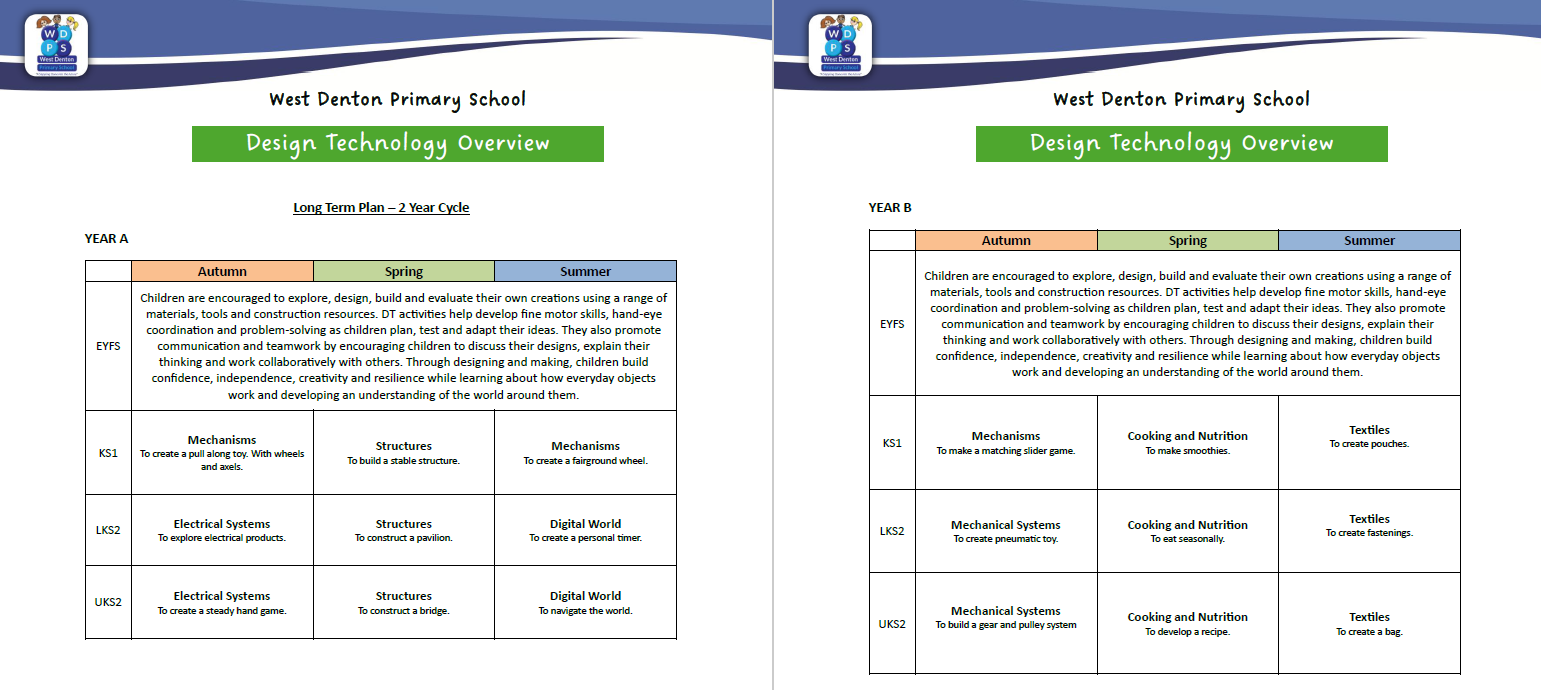
Overview