West Denton Primary School
Computing
At West Denton Primary School, we are committed to providing a purposeful and empowering curriculum that prepares all learners for their next steps in education and beyond. We recognise that computing is an essential part of everyday life, and we aim to ensure that children develop a confident, positive and enthusiastic attitude towards computing that will support them throughout their lives.
Our computing curriculum is built around the three strands of the National Curriculum: Computer Science, Digital Literacy (including Online Safety) and Information Technology. Through these, children develop key knowledge, skills and understanding while also building their sense of self, aspirations for the future and awareness of the wider world. Computing helps children make meaningful connections, develop communication skills and understand how technology shapes the world around them, both positively and negatively.
In computing, children are encouraged to develop independence and curiosity through enquiry-based learning and opportunities for hands-on experience. They are supported to take responsibility for their learning, apply their knowledge in meaningful contexts and deepen their understanding over time.
As technology continues to play an increasingly important role in modern society, our computing curriculum provides opportunities for pupils to broaden their horizons. Children are introduced to real-world applications of computing and begin to understand its importance in a range of future careers. We also aim to inspire aspiration by encouraging children to see themselves as capable and confident users of technology who can contribute positively to an ever-changing digital world.

National Curriculum Aims
At West Denton Primary School, we follow the national curriculum for computing, which aims to ensure that all pupils:
- can understand and apply the fundamental principles and concepts of computer science, including abstraction, logic, algorithms and data representation
- can analyse problems in computational terms, and have repeated practical experience of writing computer programs in order to solve such problems
- can evaluate and apply information technology, including new or unfamiliar technologies, analytically to solve problems
- are responsible, competent, confident and creative users of information and communication technology.
Key Stage 1 pupils will be taught to:
- understand what algorithms are; how they are implemented as programs on digital devices; and that programs execute by following precise and unambiguous instructions
- create and debug simple programs
- use logical reasoning to predict the behaviour of simple programs
- use technology purposefully to create, organise, store, manipulate and retrieve digital content
- recognise common uses of information technology beyond school
- use technology safely and respectfully, keeping personal information private; identify where to go for help and support when they have concerns about content or contact on the internet or other online technologies.

Key Stage 2 pupils will be taught to:
- design, write and debug programs that accomplish specific goals, including controlling or simulating physical systems; solve problems by decomposing them into smaller parts
- use sequence, selection, and repetition in programs; work with variables and various forms of input and output
- use logical reasoning to explain how some simple algorithms work and to detect and correct errors in algorithms and programs
- understand computer networks including the internet; how they can provide multiple services, such as the world wide web; and the opportunities they offer for communication and collaboration
- use search technologies effectively, appreciate how results are selected and ranked, and be discerning in evaluating digital content
- select, use and combine a variety of software (including internet services) on a range of digital devices to design and create a range of programs, systems and content that accomplish given goals, including collecting, analysing, evaluating and presenting data and information
- use technology safely, respectfully and responsibly; recognise acceptable/unacceptable behaviour; identify a range of ways to report concerns about content and contact.
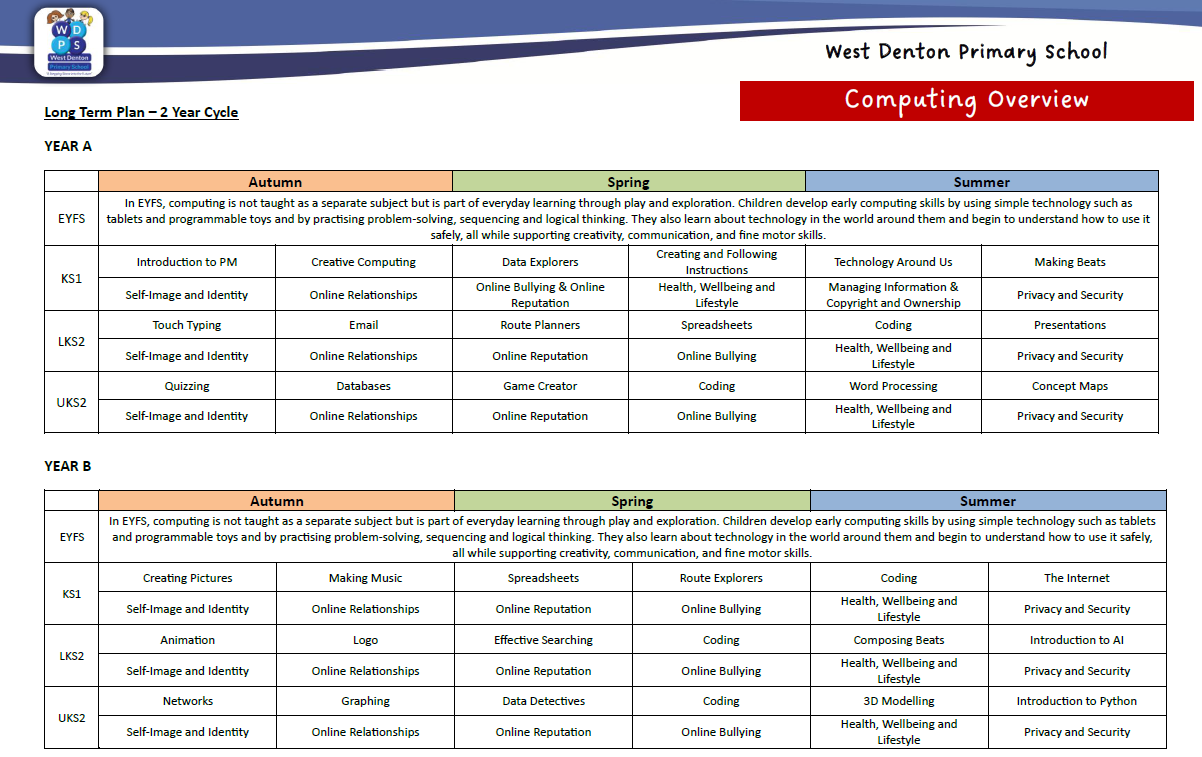
Overview